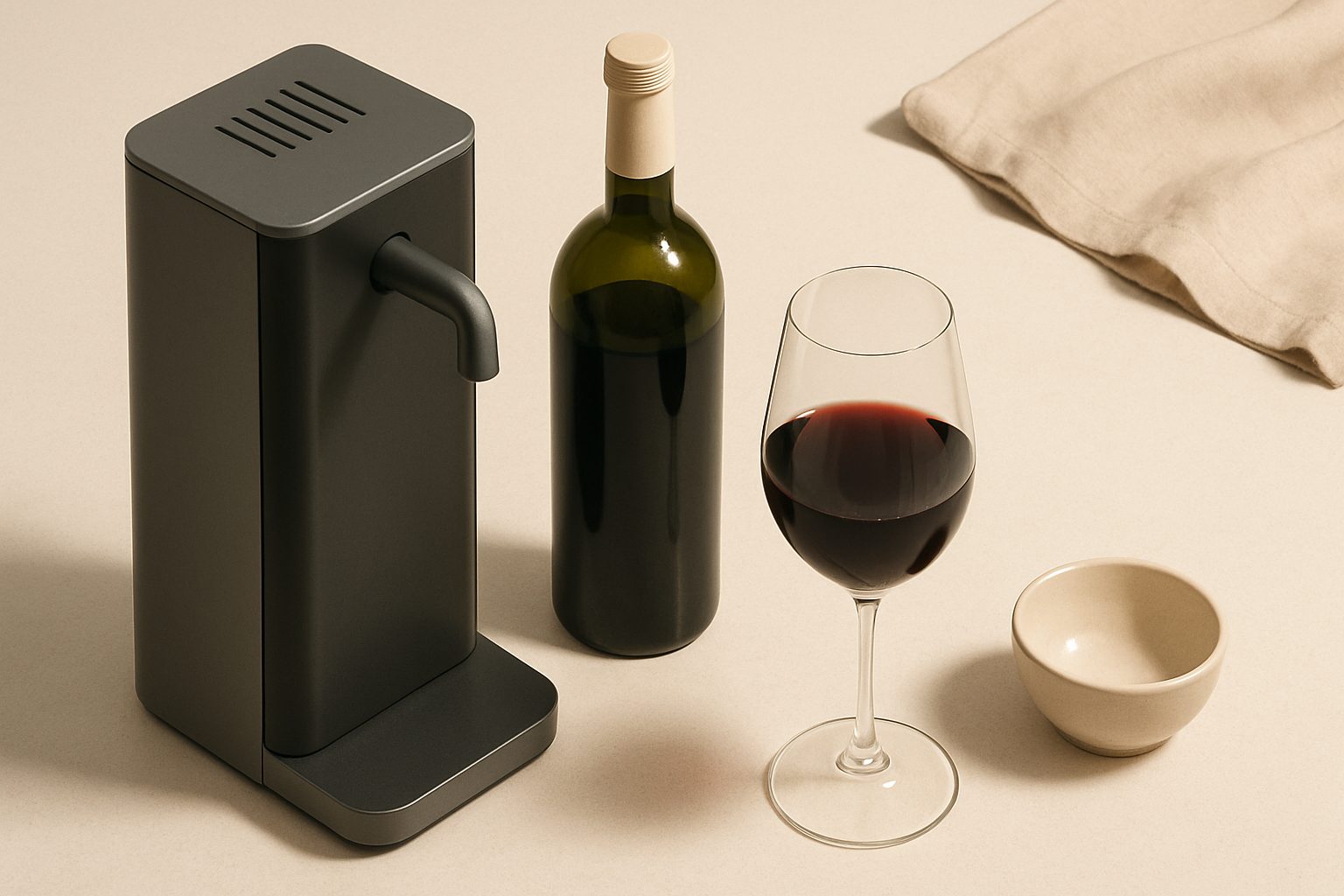
Best Wine Dispensers for Both Red and White Wine UK
Storing red and white wine at the same temperature is compromise that affects both. Red wines need warmth to express their flavour; white wines demand chill to stay crisp. A single-temperature dispenser forces you to choose, which is why dual-zone wine dispensers have become essential for anyone serious about wine at home.
The challenge isn't just temperature—it's maintaining it. Most kitchen wine dispensers sit within arm's reach of radiators, sunlight, and kitchen heat. A proper dual-zone model keeps reds at 16–18°C and whites at 7–10°C simultaneously, without the hassle of moving bottles between cupboards or fridge shelves. Here's what actually matters when you're shopping.
Why Temperature Separation Matters
Wine's flavour profile is locked in at serving temperature. Serve a good Burgundy at fridge temperature and you lose the complexity; serve Sauvignon Blanc at room temp and it tastes flat. Most people understand this in theory but compromise in practice—keeping everything in one dispenser because they can't be bothered with two units.
The result is wine that doesn't taste as good as it should, which defeats the purpose of buying decent bottles. A dual-zone dispenser solves this without taking up twice the space, because the cooling zones are stacked or compartmented within a single footprint.
What to Look For
Compressor vs. Thermoelectric Cooling
Compressor units (the mechanical humming kind) are more reliable and reach lower temperatures faster. They're noisier and use more electricity, but they'll maintain consistent temperature even if your kitchen gets warm. Thermoelectric units are quieter and cheaper, but they struggle if ambient temperature is high—so they're riskier in kitchens near ovens or in summer.
For a UK home, compressor is the safer bet, particularly if you want the whites properly chilled without constantly adjusting settings.
Capacity and Bottle Configuration
Most dual-zone dispensers hold 4–12 bottles total: typically 2–6 per zone. This sounds small, but it's practical. You're storing bottles you'll drink within weeks, not a year's worth. Bigger units (8+ bottles per zone) require more power and cool less evenly. Mid-range models (6–8 bottles total) balance accessibility with proper temperature management.
Check whether the unit holds standard 750ml bottles. Some squeeze in Champagne or magnums, but this often means the temperature zone nearest the door runs slightly warmer—fine if you're rotating stock, problematic if you're storing the same bottles for months.
Temperature Range and Accuracy
Look for models offering 5–18°C range with ±2°C accuracy. Anything wider is marketing fluff; anything less accurate is useless. Digital displays are more reliable than analogue dials. Dual independent thermostats (one per zone) are non-negotiable—if they share a thermostat, you're setting an average temperature, not two separate ones.
Noise and Size
Wine dispensers with compressors produce 35–45dB—roughly a quiet office. It's noticeable if your kitchen is open-plan. Thermoelectric units are quieter (25–35dB) but, again, less reliable. Measure your space before buying. Most compact dual-zones are 50–60cm wide and 65–85cm tall—fitting under a counter or in a corner, but not invisible.
Real Pros and Cons
Pros:
- Eliminate the fridge shuffle: whites stay crisp without eating fridge real estate.
- Serve wine at the correct temperature without guesswork.
- Reduce oxidation: bottles sit undisturbed, sealed, in stable conditions.
- Compact relative to running two separate units.
- Energy use is lower than you'd expect—roughly 150–300W for most models.
Cons:
- Compressor units create audible hum, especially at night in quiet kitchens.
- Limited bottle capacity means you're restocking frequently if you drink regularly.
- Upfront cost is £300–800 for a decent dual-zone model.
- They require space on a worktop, in a corner, or under counter—not suitable for tiny kitchens.
- Shelves can be tricky to clean around; dust builds up over time if you don't wipe weekly.
How to Set One Up
Place the unit on a level, stable surface away from direct sunlight and radiators. Leave 10cm clearance on the sides for airflow. Set the red zone to 16–18°C and white zone to 8–10°C. Don't open the door unnecessarily—each opening takes 20–30 minutes to restabilise temperature.
Stock it with bottles you'll drink within 4–8 weeks. Wine dispensers aren't long-term storage; they're serving units. Leave them on continuously—cycling on and off costs more energy and creates temperature swings.
The Right Choice Depends on Drinking Habits
If you drink one bottle a week and have guests regularly, a 6–8 bottle dual-zone compressor model pays for itself in convenience. If you're a casual drinker or prefer whites only, a single-zone thermoelectric unit saves money and space.
For most UK homes wanting both reds and whites ready to serve, a mid-range compressor dual-zone with 6–8 total capacity strikes the right balance between cost, reliability, and practicality.
The key insight: proper temperature storage isn't luxury—it's how wine is meant to taste. A dual-zone dispenser finally makes that straightforward.
More options
- Electric Home Wine Dispensers (Amazon UK)
- Wine Preservation Systems (Argon / Vacuum) (Amazon UK)
- Countertop Wine Cooler Dispensers (Amazon UK)
- Box Wine Dispensers & Bag-in-Box Taps (Amazon UK)
- Wine Dispenser Gift Sets (Amazon UK)